Your Probiotic Capsule Is Probably Already Dead — And Your Gut Knows It
Walk into any Whole Foods, Walgreens, or CVS in America and you'll find an entire wall dedicated to probiotic supplements. Fifty billion CFUs. A hundred billion. "Clinically studied strains." Shelf-stable formulas. Refrigerated formulas. Delayed-release capsules designed to survive your stomach acid.
The marketing is impressive. The science? A lot messier.
Here's the part the label doesn't mention: even if those bacteria survive the gauntlet of your digestive system — which is a significant "if" — they're essentially tourists in your gut. They show up, look around, and leave within days to weeks. They don't set up permanent residence. They don't fundamentally reshape your microbiome. And for many people, they don't deliver the dramatic digestive transformation the packaging implies.
So why are we spending an estimated $60 billion a year on them globally?
The Stomach Acid Problem Nobody Wants to Talk About
Your stomach is, by design, a hostile environment. Hydrochloric acid with a pH that can drop as low as 1.5 to 3.5 — roughly comparable to battery acid — exists specifically to break down what you eat and kill pathogens before they reach your intestines. It's one of your immune system's most underappreciated defenses.
It's also extremely effective at killing the bacteria in your probiotic capsule.
Studies have consistently shown that a significant percentage of probiotic bacteria in supplements don't survive gastric transit. Estimates vary depending on the strain and formulation, but survivability rates can be startlingly low. Manufacturers have tried to engineer around this with enteric coatings and delayed-release capsules, and some of those innovations do improve survival rates — but "more bacteria surviving" still doesn't answer the deeper question of whether surviving bacteria actually do anything meaningful once they arrive.
Colonization: The Myth of the Permanent Resident
Even the probiotics that make it through your stomach face another challenge: your existing microbiome is not exactly rolling out the welcome mat.
Your gut is already colonized by trillions of microorganisms — bacteria, fungi, viruses, and archaea — that have been establishing their territory since you were born. That community has its own ecology, its own competitive dynamics, and its own resistance to outside invasion. Introducing a few billion standardized bacteria from a capsule into that ecosystem is a bit like releasing a handful of non-native fish into an established river system and expecting them to take over.
Research has actually found that in some people, probiotic supplementation can delay the natural recovery of the microbiome after antibiotics — the opposite of what most people take them for. A 2018 study published in Cell showed that the gut microbiome of people who took probiotics after antibiotics took longer to return to baseline than those who just let their microbiome recover on its own.
None of this means probiotics are useless across the board. For specific clinical applications — particular strains for particular conditions, like Lactobacillus rhamnosus GG for certain types of antibiotic-associated diarrhea — the evidence is reasonably solid. But the idea that a daily multi-strain capsule is maintaining or rebuilding your gut health in any meaningful, lasting way? That's more faith than science.
What Your Great-Grandmother Understood That We've Forgotten
Here's where it gets genuinely interesting. While the supplement industry was busy counting CFUs, food scientists and microbiologists started paying closer attention to traditional fermented foods — and finding something the capsules couldn't replicate.
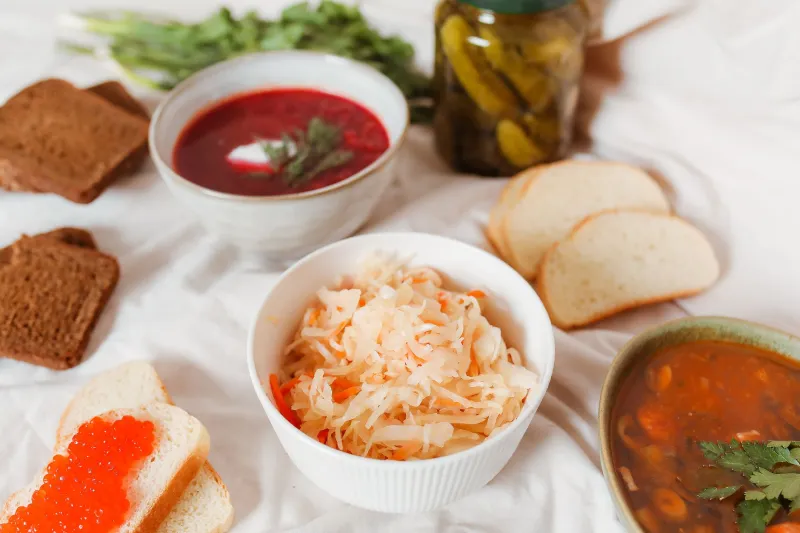
Kimchi. Kefir. Sauerkraut made the old way, with just cabbage and salt. Miso. Kombucha when it's actually alive and not pasteurized into submission. These foods aren't just delivering live bacteria — they're delivering a complex ecosystem of microorganisms, metabolites, enzymes, organic acids, and bioactive compounds that interact with your gut in ways a standardized bacterial strain in a capsule simply cannot.
A 2021 Stanford study published in Cell compared a high-fiber diet to a fermented food diet over ten weeks. The fermented food group showed increased microbiome diversity — one of the key markers of gut health — and decreased markers of inflammation. The high-fiber group, interestingly, did not show the same diversity increase, possibly because without the right microbial community present, the fiber had nothing to ferment it.
Microbiome diversity matters because a diverse gut ecosystem is a resilient one. It's harder for pathogens to gain a foothold, more capable of producing the short-chain fatty acids that feed your gut lining, and better equipped to regulate immune function and — notably for this category — sleep and recovery.
The Gut-Brain-Sleep Connection You Didn't See Coming
About 90% of your body's serotonin is produced in the gut. Your microbiome influences the production of GABA, the primary inhibitory neurotransmitter that helps your nervous system downshift for sleep. Gut bacteria also play a role in regulating the vagus nerve — the long, wandering nerve that connects your gut to your brain and is central to your rest-and-digest response.
When your gut ecosystem is disrupted — by antibiotics, chronic stress, a diet high in processed food, or even just low diversity — the downstream effects on your nervous system and sleep quality are real. Some researchers now believe that gut dysbiosis (an imbalanced microbiome) may be an underappreciated contributor to insomnia, anxiety, and the kind of low-grade fatigue that no amount of sleep seems to fix.
Traditional fermented foods may support this gut-brain axis in ways that supplement probiotics don't, partly because they contain a broader range of metabolites and partly because they're consumed as part of a food matrix that changes how the gut processes them.
Building a Gut Ecosystem Instead of Renting One
So what's the renegade approach here? Stop trying to colonize your gut with a capsule and start thinking about building an environment where beneficial bacteria can thrive on their own terms.
Eat fermented foods regularly — but make sure they're actually alive. Most commercial sauerkraut and pickles on grocery store shelves are pasteurized, which kills the bacteria. Look for refrigerated, raw fermented vegetables, or better yet, make your own. It's genuinely not complicated: cabbage, salt, a jar, and time.
Feed the bacteria already living in you. Prebiotic fibers — found in garlic, onions, leeks, asparagus, Jerusalem artichokes, and underripe bananas — feed your existing beneficial bacteria. This is often more impactful than trying to add new ones.
Reduce the things that disrupt your microbiome. Antibiotics when you don't genuinely need them, ultra-processed foods, chronic sleep deprivation, and unmanaged stress all degrade gut diversity in documented ways.
If you're going to use probiotics, be specific. Don't just grab whatever has the highest CFU count. Look for strains that have actual clinical evidence for your specific concern, and understand that the benefit is likely temporary and situation-specific rather than a long-term microbiome transformation.
The supplement industry has done something remarkable: it took one of the most complex ecosystems in human biology, reduced it to a number on a label, and sold it back to us for thirty dollars a bottle. Your gut is worth more than that — and so is your skepticism.